With 20 years of R&D experience in proportional valves and servo valves, Our company is a professional Chinese manufacturer. Our products can fully replace equivalent models from MOOG and Rexroth.Please feel free to contact us if you have any requirements for servo valve selection and replacement for ceramic presses.
1. Application of Servo Valves in Ceramic Presses
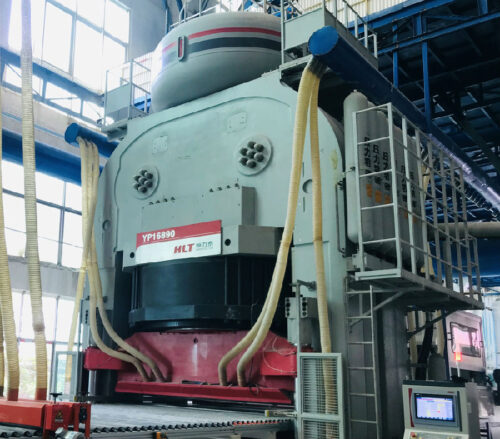
Ceramic presses use high pressure to compact ceramic powder into fixed-size green bodies for tiles and ceramics. Servo valves are core control components for this equipment. They have two main application fields:
- Building ceramics (main application)
This type of press produces full-body tiles, polished tiles, antique tiles, large ceramic slabs and thin tile green bodies. It is essential for tile production lines. Small-tonnage presses make small tiles, while ten-thousand-ton presses manufacture extra-large ceramic slabs.
- Special industrial ceramics
The equipment also forms alumina/zirconia ceramic substrates, wear-resistant ceramic parts, electronic ceramic components and refractory bricks through dry pressing.
2.Technical Specifications for Servo Valves in Ceramic Presses
2.1 Hydraulic Parameters
- Working pressure: The rated system pressure ranges from 25 to 31.5 MPa, and the peak pressure reaches 35 MPa under high-load pressing conditions.
- Flow rate: The main cylinder servo valve runs at 60 to 250 L/min. The ejection and material distribution servo valves work at 15 to 60 L/min.
- Performance indicators: The servo valve adopts center closed design. Its dead zone is less than 3% FS, hysteresis is no more than 0.3% FS, and linearity stays within ±0.3% FS.
- Frequency response: The frequency response is at least 50 Hz (-3dB). High-end models reach 80 to 100 Hz. This meets the requirement of 2 to 4 pressing cycles per second for high-speed operation.
- Oil cleanliness: The hydraulic oil needs to meet NAS 6~7 level. Since tile workshops have much dust, install a two-stage filtration system: a main filter plus a 3μm bypass fine filter for servo valves.
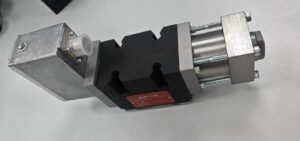
2.2 Electrical Parameters
- Control signal: Standard input is ±10 V analog signal or 4~20 mA signal. The power supply is 24 VDC.
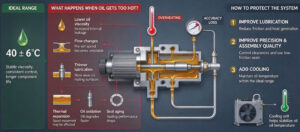
- Environmental resistance: The servo valve works stably for a long time when oil temperature is 40~55 °C. It also resists dust and humid on-site conditions.
3. Selection Guidelines for Servo Valves in Ceramic Presses
- Match flow rate with press tonnage: Choose 60 L/min or 80 L/min servo valves for presses below 3200 tons. Select 120~250 L/min servo valves for slab presses above 5000 tons.
- Prioritize anti-pollution structures: Use two-stage nozzle-flapper servo valves or direct-acting servo valves such as Moog and Rexroth products. Avoid jet pipe servo valves, because they are too precise and vulnerable to workshop dust.
- Confirm control mode: Equip full closed-loop systems (pressure + displacement dual closed loop) with standard servo valves. Closed-loop proportional servo valves are acceptable for simple pressure regulation.
- Installation requirements: Use plate-type integrated mounting. Reserve an external drain port, and keep the return pressure of port T below 0.5 MPa.
- Supporting accessories: Always fit a 3μm high-pressure fine filter at the front end of each servo valve. This prevents valve blockage effectively.
4. Common Faults and Causes of Servo Valves in Ceramic Presses
- Spool sticking and unsmooth movement –This is the most frequent fault. Dust exceeds standard in hydraulic oil, or damaged filter cartridges let impurities enter the servo valve.
- Zero drift and uneven tile thickness –Reasons include aging torque motor, oil temperature over 60 °C and drift of zero offset circuit in the servo valve.
- High internal leakage and pressure drop during pressure holding–The spool and valve sleeve wear out, or water mixes into hydraulic oil and causes oil emulsification inside the servo valve.
- Slow response and delayed pressure application–Throttling holes get clogged, or the pilot supply pressure is insufficient for the servo valve.
- Coil burnout and valve failure–On-site moisture enters the coil, or unstable power supply damages the servo valve coil.
5 Imported Original Matched Servo Valves (KEDA, HLT, SACMI Presses)
a) Moog (Matching HLT high-end presses and SACMI extra-large tonnage presses)
- D634-341C: 60 L/min direct-acting servo valve, for ejection and material distribution
- D661-4651, D662: 100~200 L/min servo valve, for main cylinder closed-loop pressure control
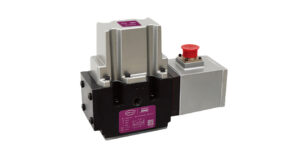
b) Rexroth (First choice for KEDA presses and modified domestic presses)
- 4WSE2EM10: 60 L/min proportional servo valve
- 4WSE3EE25: 120~240 L/min large-flow proportional servo valve for main cylinders
c) Parker (Standard for original SACMI imported presses)
- D1FW series, BD series: Servo valves and closed-loop proportional servo valves
d) ATOS (Italy) (Matching SITI, SITI B&T and SYSTEM Italian slab presses)
- DLHZO series: Closed-loop proportional servo valves, for medium and small flow ejection and material distribution
For valve selection and replacement of servo valves, proportional valves and amplifiers, reach us on WhatsApp: +86 15071021309. Our expert engineers offer comprehensive technical support.