Radk Hydro is a professional manufacturer of proportional servo valves as well as a supplier of proportional servo valve testing equipment. We offer customized test bench solutions, portable on-site inspection devices, and professional repair services for proportional and servo valves. Please feel free to contact us if you have any relevant requirements.
Hydraulic Oil Management
- Contamination Monitoring
Oil contamination greatly cuts proportional servo valve performance and service life. Test oil cleanliness every 2000 working hours or every 3 months with a particle counter. Follow ISO 4406 standard, and keep cleanliness level ≤18/16/13. If contamination exceeds limits, replace filter elements or purify oil right away. Solid particles block valve ports, scratch spool and sleeve, and damage sealing and control precision.
- Viscosity & Temperature Control
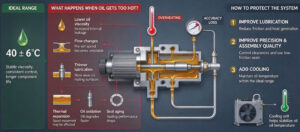
Keep oil viscosity within the range listed in product manuals (32–46 cSt for common hydraulic oil). Oil temperature over 60℃ speeds up oil aging, weakens lubrication and raises internal valve wear. Install coolers to stabilize oil temperature. Low oil temperature makes oil too viscous. The spool moves slowly or even sticks. Preheat oil to suitable temperature before startup.
Valve Body Inspection
- Visual & Mounting Check
Check valve body regularly. Look for cracks, deformation and oil leakage marks. Check loose flanges and threads to secure full installation. Shut down equipment immediately if you spot abnormal valve conditions to stop larger failures. For valves with mechanical feedback units, inspect levers and connecting rods for jamming or wear to keep joints flexible.
- Electrical Connection Check
Make signal wires and power cables connect tightly. Ensure terminals have no looseness, oxidation or damage, and plugs fit sockets well. Waterproof seals cannot age. Add extra seal protection for electrical parts in humid environments. Water intrusion causes short circuits or open circuits, which break signal transmission and solenoid drive functions of proportional valves.
- Seal Maintenance
Watch oil leakage at sealing positions: valve body and end caps, spool and sleeve. Replace aged, cracked or hardened O-rings at once. Choose FKM fluoro rubber or NBR nitrile rubber seals matching manual specifications. Install seals gently to avoid scratches. Good sealing prevents system pressure drop and unstable flow caused by hydraulic oil leakage.
Performance Test & Calibration
- Static Performance Test
Run static performance tests regularly. When no control signal inputs, check whether output pressure and flow stay zero. If offset exists, adjust electric zero or mechanical regulators following manuals. Input rated control signals from 0 to 100% (0–10V voltage or 4–20mA current). Record corresponding pressure and displacement values and draw characteristic curves. Linear deviation must be ≤±3% FS (full scale). If deviation exceeds the limit, check signal sources and internal spool wear.
- Dynamic Response Test
Use step signals (sudden 50% rated signal change) to test dynamic performance. Use oscilloscopes to record response time and overshoot. Standard target: pressure rise time ≤50ms, overshoot ≤10%. Slow response or abnormal overshoot usually comes from high oil viscosity, blocked damping holes or worn spools. Carry out targeted maintenance.
- Periodic Calibration
Connect proportional valves to professional test benches every quarter. Verify core indicators: step response time, hysteresis error and repeat accuracy. Standard indexes: step response ≤30ms, hysteresis error ≤1.2%, repeat accuracy ≤0.8%. If linear deviation exceeds 3%, clean or replace spool assemblies to keep valves meet design performance standards.
Electrical System Maintenance
- Solenoid Coil Test Test insulation resistance of proportional solenoid coils with megohmmeters regularly. Resistance needs to stay above 50 MΩ. Low insulation resistance means damp or shorted coils. Dry or replace coils in time to avoid burnout and failed solenoid driving.
- Amplifier Maintenance Check amplifier settings: gain, dead zone and ramp time. Match parameters to working conditions. Re-calibrate with tuning software like Rexroth IndraWorks if parameters drift and trigger control errors. Monitor cooling fan speed of amplifiers to keep operating temperature below 60℃. High temperature shortens amplifier service life and weakens performance.
- Signal Cable Maintenance Test grounding resistance of cable shielding layers every six months. Keep resistance under 1Ω. Reliable grounding eliminates electromagnetic interference and signal distortion, so control signals transmit accurately to proportional servo valves.