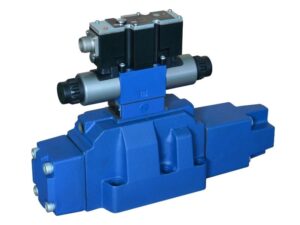
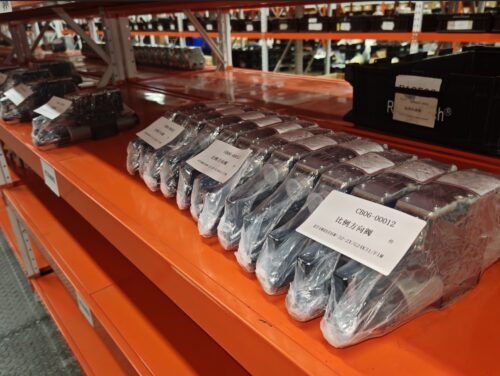
Radk Hydro is a professional manufacturer of servo valves and proportional valves with 2 years of R&D experience. Our products are currently exported to more than 30 countries worldwide, and can fully replace equivalent products from MOOG, Rexroth and HAWE.Feel free to contact us anytime for product inquiries or professional selection guidance.
In modern hydraulic system design, control valves directly determine equipment control accuracy, response speed, operation stability and overall cost.
Directional valves, proportional valves and servo valves are the three most widely used electro-hydraulic control components in industrial applications. However, many designers often face problems such as over-specification causing waste or under-specification leading to unstable operation.
Core Positioning and Essential Differences of the Three Types of Valves
- Directional valves mainly adopt on-off logic control to realize direction change, start and stop of hydraulic cylinders and motors.
- Proportional valves enable continuous adjustable pressure and flow, suitable for general proportional control.
- Servo valves are designed for high-precision and high-response closed-loop control, standing as top-tier electro-hydraulic components.
- Choose directional valves if continuous regulation is not required;
- Choose proportional valves for medium-precision control;
- Choose servo valves for ultra-high precision and dynamic control.
Clarifying this positioning is the foundation of hydraulic component selection.
Selection Key Points of Directional Valves: Prioritize Logic Control and Reliability
Selection Key Points of Proportional Valves: Balance Continuous Control and Cost Efficiency
Proportional valves are the ideal choice when the system needs smooth speed regulation, flexible pressure application and gradual position control without ultra-high precision requirements.
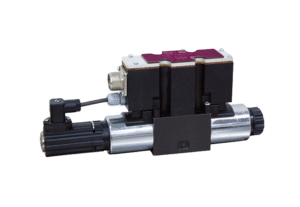
They are widely used in injection molding machines, die-casting machines, hydraulic presses, construction machinery, metallurgical equipment and other mainstream industrial machinery.
Proportional valves are moderately priced and have better pollution resistance than servo valves, meeting the control needs of most industrial equipment.
In system design, proportional valves are preferred when control accuracy is within 1%~3% and response frequency is below 50Hz.
Selection Key Points of Servo Valves: Only for High-Precision Closed-Loop Applications
Servo valves are high-end electro-hydraulic components with zero overlap, small dead zone, fast response and high precision.
They are mainly used in simulation testing machines, servo presses, radar tracking systems, aerospace equipment and high-precision test benches.
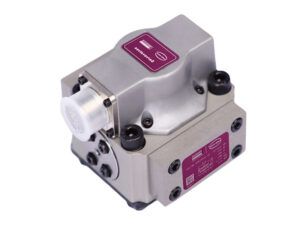
Due to their precise structure, servo valves require extremely high hydraulic oil cleanliness, with high procurement cost and difficult maintenance.
In system design, follow the principle: do not adopt servo valves unless high-precision closed-loop control is required. Blind high-end configuration will cause system instability, short service life and high maintenance cost.
Five-Step Quick Selection Method for Hydraulic System Design
- Check if continuous flow regulation is needed. If not, select a directional valve directly.
- Judge whether it is a high-precision and high-dynamic closed-loop control system. If not, proceed to proportional valve selection.
- Confirm requirements for control accuracy, response speed and frequency response; choose proportional valves for medium performance requirements.
- Evaluate on-site environment, oil filtration capacity and maintenance conditions; avoid servo valves under ordinary working conditions.
- Under the premise of meeting performance requirements, prioritize solutions with lower cost and easier maintenance.
The Most Suitable Component Is the Best Choice
- Directional valves: undertake basic logical actions with high reliability and low cost.
- Proportional valves: realize continuous proportional control with balanced performance and practicality.
- Servo valves: deliver high-end precise closed-loop control with top-level performance.
The core of hydraulic system design is to select the most matched, stable and cost-effective components while satisfying technological requirements.
Only by fully understanding the performance limits, control logic and application conditions of the three types of valves can designers complete one-time accurate selection. This makes the hydraulic system operate more efficiently, energy-saving, stably and durably.