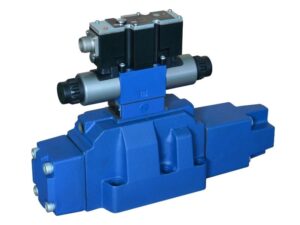
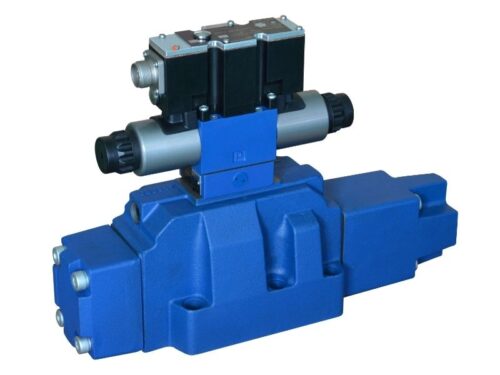
We supply drop-in replacement proportional valves for Rexroth. Our technical engineers support you with professional valve selection. Share your system parameters with us to get a matched solution.
1.Basic Concepts: Pilot Supply & Drain Type
1.1 Pilot supply (how the valve shifts)
| Type | Where does the pilot oil come from? | Working Principle |
| Internal Pilot | Pilot oil is supplied directly from main port P of the valve. | When energized, the solenoid actuates the valve. If there is no pressure at port P, the valve cannot shift. |
| External Pilot | Separate pilot line connected to an external oil source (pilot pump / accumulator) | The valve can shift even when main line P has no pressure, as long as external pilot pressure is available. |
1.2 Drain type (where pilot return oil flows)
| Type | Where does the pilot drain flow to? | Effect |
| Internal Drain | Pilot return oil flows into main return port T | Simple structure, but backpressure on T will act on the pilot spool. High backpressure causes slow or failed shifting. |
| External Drain | Pilot oil returns directly to tank via separate Y port. | No backpressure on pilot stage for fast, stable shifting; requires an extra pipe. |
Quick summary: Pilot type = where the drive oil comes from. Drain type = where pilot oil returns. Four combinations are available
2. Four combinations
2.1 Internal Pilot + Internal Drain
| Item | Content |
| Structure | Pilot oil from P, pilot return to T. |
| Advantages | Simplest piping, low cost, compact layout |
| Disadvantages | Affected by T port backpressure; no operation when P has no pressure |
| Typical Application | Simple machine tools, small-flow single-pump systems. |
⚠️ Notes: T port backpressure ≤1~2 bar. Not suitable for multi-actuator systems or O-type center function valves.
2.2 Internal Pilot + External Drain
| Item | Content |
| Structure | Pilot oil from P, pilot return to tank via independent Y port. |
| Advantages | Immune to main return line backpressure, stable shifting. |
| Disadvantages | Requires one extra drain line. |
| Typical Application | Medium / medium-high pressure multi-actuator systems, pressure holding circuits with O-type center. |
- Port Y must connect directly to the tank. Do not connect it to main return port T. This connection will turn it into internal pilot, internal drain.
- If port Y is mistakenly connected to port T, slow shifting or incomplete valve stroke will occur. This is the most common mistake on site.
- O-type spool function can be used. Port P is blocked inside the valve with no external leakage. The main circuit keeps pressure during hold. Internal pilot still gets oil for next operation.
- It is recommended as the default general selection. It needs one extra pipe compared with internal pilot internal drain. In return, you get better shifting reliability and higher back pressure resistance.
2.3 External Pilot + Internal Drain
| Item | Content |
| Structure | Pilot oil from external source (accumulator / pilot pump), pilot return to T. |
| Advantages | Valve still operates even when main pump loses pressure for emergency functions. |
| Disadvantages | Affected by T backpressure; extra pilot supply pipe required. |
| Typical Application | Emergency safety circuits, emergency shutdown, retracting mechanisms. |
⚠️ Notes: External pilot source must maintain pressure during power loss (accumulator).
- The external pilot oil supply must have redundancy. It maintains pressure even after power loss (using accumulators or backup pumps).
- Back pressure at port T still needs control. The return line must remain unobstructed, same as internal pilot internal drain type.
- Typical application: The pilot circuit uses an accumulator to hold pressure. When the main pump stops, the accumulator still supplies oil to move the valve. This is the core benefit of external pilot control.
- Suitable for applications where valve movement must be guaranteed, such as metallurgical furnace doors, crane hooks, fire safety valve control.
2.4 External Pilot + External Drain (Top configuration)
| Item | Content |
| Structure | Pilot oil from external source; pilot return to tank via separate Y port. |
| Advantages | Fully independent. Main circuit backpressure or main pressure loss will not affect valve operation. Highest reliability. |
| Disadvantages | Two extra lines, highest complexity and cost. |
| Typical Application | High pressure & large flow, safety redundant circuits, servo / proportional systems, high-frequency shifting. |
- Pilot supply pressure must stay stable. Typical range: 20~30 bar. Too high pressure will damage the valve.
- The pilot oil requires finer filtration than the main circuit. Normally 5~10 μm. Contaminants will block the pilot stage first.
- Standard setup for power-loss protection circuit: connect pilot line to accumulator for pressure holding, and drain line directly to tank.
- When multiple electro-hydraulic directional valves are stacked, external pilot + external drain is recommended for every section to prevent mutual interference.
3. Comparison Table
| Type | Pilot Supply | Pilot Return | Works after main P pressure loss | Resistance to T backpressure | Complexity | Application |
| Internal Pilot + Internal Drain | Port P | Port T | ❌ No | ✅ Yes ❌ Poor | ★☆☆ | Simple low-flow |
| Internal Pilot + External Drain | Port P | Separate tank | ❌ No | ✅ Good | ★★☆ | Medium systems (recommended default) |
| External Pilot + Internal Drain | External source | Port T | ✅ Yes | ❌ Poor | ★★☆ | Emergency circuits |
| External Pilot + External Drain | External source | Separate tank | ✅ Yes | ✅ Good | ★★★ | Critical / servo systems |
4. Selection Checklist
- Does the valve need to function after main hydraulic pressure fails?
- Is the return line T with high or fluctuating backpressure?
- Is O-type center function required for pressure holding?
- Is the system high pressure, large flow or high-frequency shifting?
Key Installation & Operation Notes
- Check port marking P/T/A/B. Wrong connection reverses actuator movement.
- Y port of External Pilot + External Drain must go directly to tank, do not connect to T.
- External pilot pressure: 20~30 bar. Overpressure damages pilot parts. Start pilot supply before main pressure.
- Pilot oil filtration: 5~10 μm, finer than main circuit.
- Operating oil temperature: -20 ~ 80°C. Oil viscosity: ISO VG32~46.
- O-type center cannot be used with Internal Pilot + Internal Drain.
- Solenoids: AC and DC cannot be mixed; long energization recommend wet solenoid with permanent magnet. Protection class ≥IP65.
Troubleshooting
- Valve will not shift: Check pilot pressure → check solenoid power → inspect spool.
- Slow valve shifting: Check backpressure at T port or Y port.
- Spool shifts but actuator does not move: Check internal leakage from center function.
Quick Selection Reference
| Your Application | Recommended Type | Reason |
| Simple machine tool, single cylinder | nternal Pilot + Internal Drain | Low cost, simple piping |
| Medium system, multiple actuators | Internal Pilot + External Drain | Resist backpressure, good value |
| Emergency operation after power loss | External Pilot + Internal / External Drain | Works without main pump pressure |
| High pressure, large flow, critical / servo circuit | External Pilot + External Drain | Most reliable performance |
| Pressure holding circuit with O-type center | External Pilot + External Drain | Prevent unexpected pressure loss |
Summary
Internal Pilot + Internal Drain costs less but is sensitive to backpressure.
Internal Pilot + External Drain works well for most common systems.
External Pilot keeps the valve working during main pressure loss.
External Drain removes backpressure interference.
External Pilot + External Drain is the full-option choice for critical circuits.
Ask two questions for fast selection: Do you need valve movement after main pressure loss? Is there high backpressure in the return line?