
1 Overview of Servo Valves in Continuous Casting Machines
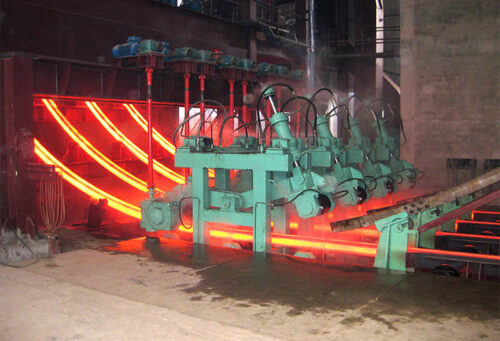
Continuous casting is a core process in modern steel production. Its control precision directly impacts the quality of steel products and production efficiency. In continuous casting equipment, servo valves act as key actuators in electro-hydraulic control systems. They deliver high-precision motion control for multiple critical components of the caster by accurately regulating flow and pressure in the hydraulic system.
2 Common Applications of Servo Valves in Continuous Casting Machines
2.1 Mold Vibration Control
Mold vibration is a make-or-break process in continuous casting. Its performance directly affects billet surface quality and caster productivity. Modern casters mostly use hydraulic servo vibration systems instead of traditional mechanical vibration devices. The main advantage is that servo valve-controlled hydraulic vibration systems allow flexible waveform adjustment and real-time parameter tuning.
In mold vibration systems, servo valves work under high-frequency, long-stroke conditions. This leads to faster wear and increased zero-position leakage, which in turn causes higher zero-position current and jitter at the peak of the vibration curve. Additionally, the harsh high-temperature environment of continuous casting can easily damage position sensor systems—poor cooling leads to malfunctions and erratic signals, challenging the reliable operation of servo valves. In practice, servo valve-controlled hydraulic vibration systems can achieve non-sinusoidal vibration patterns. This type of waveform effectively reduces friction between the billet and mold, enhances lubrication between the billet shell and mold, and ultimately improves billet surface quality.
2.2 Dynamic Soft Reduction & Hydraulic Roll Gap Control
Dynamic soft reduction technology is one of the core technologies for improving internal billet quality in modern casters. It uses servo valves to precisely control the shrinkage of segment roll gaps, compensating for volume shrinkage during billet solidification. This minimizes internal defects like central porosity and shrinkage cavities. In this application, servo valves need to adjust roll gap openings in real time based on casting speed, steel grade, and cooling parameters—control precision typically needs to reach the micron level.
2.3 Casting Speed Control
In horizontal continuous casting, casting speed control places particularly strict demands on servo valve performance. The electro-hydraulic servo drive for billet casting must precisely regulate casting rhythm, speed, and counter-thrust according to the characteristics of horizontal continuous casting processes. This prevents billet shell breakage or tearing due to excessive resistance. Here, servo valves work with tachometers and servo motors to form a complete position-speed closed-loop control system.
The unique challenge of casting speed control lies in handling large inertial loads and hydraulic shocks from high-frequency reversing—while maintaining extremely high speed control precision. Even minor fluctuations can lead to unstable billet quality or production interruptions. Therefore, servo valves in this application must have exceptional resolution and fast response capabilities to ensure smooth, accurate casting.
| Application | Control Precision Requirement | Operating Frequency | Key Technical Challenges |
| Mold Vibration Control | High (displacement control ±0.1mm) | High frequency (up to 400 cycles/minute) | Faster wear from high-frequency vibration; prone to zero-position drift |
| Hydraulic Roll Gap Control | Ultra-high (±0.01mm) | Low frequency (adjusted with casting speed) | High contamination resistance required; maintaining long-term precision |
| Casting Speed Control | High (speed control ±0.5%) | Medium frequency (adjusted with casting rhythm) | Handling large inertial loads; need for fast response |
3 Common Faults & Troubleshooting for Servo Valves in Continuous Casting Machines
| Fault Phenomenon | Diagnostic Methods | Troubleshooting Steps |
| Servo Valve Jamming | Detect sudden changes in vibration curves; check for filter blockages | Clean the valve’s internal filter element; replace hydraulic oil |
| Large Zero Deviation/Drift | Measure zero deviation with a test bench; inspect for component wear | Adjust zero deviation; replace worn parts |
| Increased Internal Leakage | Test actuator pressure retention; check system temperature rise | Replace valve spool and sleeve; update seals |
3.1 Simplified Fault Diagnosis Flowchart
- Observe abnormal performance (e.g., jitter, inaccurate control, slow response)
- Use diagnostic methods from the table above to identify potential causes
- Perform targeted troubleshooting steps (e.g., check oil cleanliness, inspect worn parts)
- Verify if the issue is resolved by testing valve performance
- Implement prevention strategies to avoid recurrence
3.2 Detailed Daily Maintenance Checklist
| Maintenance Item | Frequency | Operation Details |
| Hydraulic oil cleanliness check & filter replacement | Every 2 weeks | Test oil cleanliness with a particle counter; replace filter elements if cleanliness exceeds NAS1638 Grade 5 |
| Servo valve zero-position calibration | Monthly | Use a professional test bench to adjust zero deviation to within ±0.05mm; record calibration data |
| Seal & component inspection | Every month | Check valve core, sleeve, and seals for wear, corrosion, or deformation; replace damaged parts immediately |
| System temperature & pressure monitoring | During daily operation | Maintain system temperature between 35–55°C; monitor pressure fluctuations (no more than ±5% of set value) |
| Damping orifice & pilot stage cleaning | Quarterly | Disassemble and clean damping orifices with high-pressure air; inspect pilot stage for blockages or wear |
| Position sensor & cooling system check | Every 2 months | Verify sensor signal stability; clean cooling ducts to ensure adequate heat dissipation; replace faulty sensors promptly |