
Coil Wiring
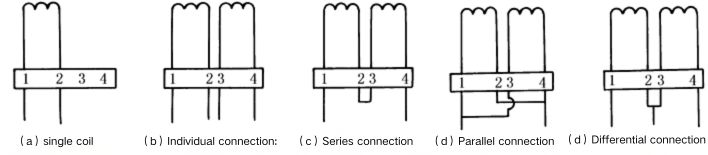
Most servo valves have two control coils (some have one), with selectable connection methods as follows:
- Individual connection: One coil for control signal, the other for flutter signal; single-coil models superimpose flutter on control signal.
- Series connection: Doubles coil turns and resistance, halves current.
- Parallel connection: Halves resistance, current remains unchanged. Advantages: High reliability (works if one coil fails, supported by deep current feedback amplifiers).
- Differential connection: Symmetrical circuit, compensates for temperature and power supply fluctuations.
Flutter Signal Application
Flutter signals maintain the valve in high-frequency, low-amplitude micro-vibration, reducing/eliminating static friction-induced dead zones and preventing blockage (no effect on torque motor hysteresis-related hysteresis value).
- Waveform: Sine wave (preferred), triangular wave, or square wave.
- Amplitude: Peak value > valve dead zone; main spool amplitude = 0.5%-1% of maximum stroke (excessive amplitude causes load interference and component wear).
- Frequency: 2-4x control signal frequency (avoids interference); not too high (higher frequency needs larger amplitude due to torque motor filtering); not a multiple of servo valve/power component resonant frequency (prevents resonance).
Servo Valve Adjustment
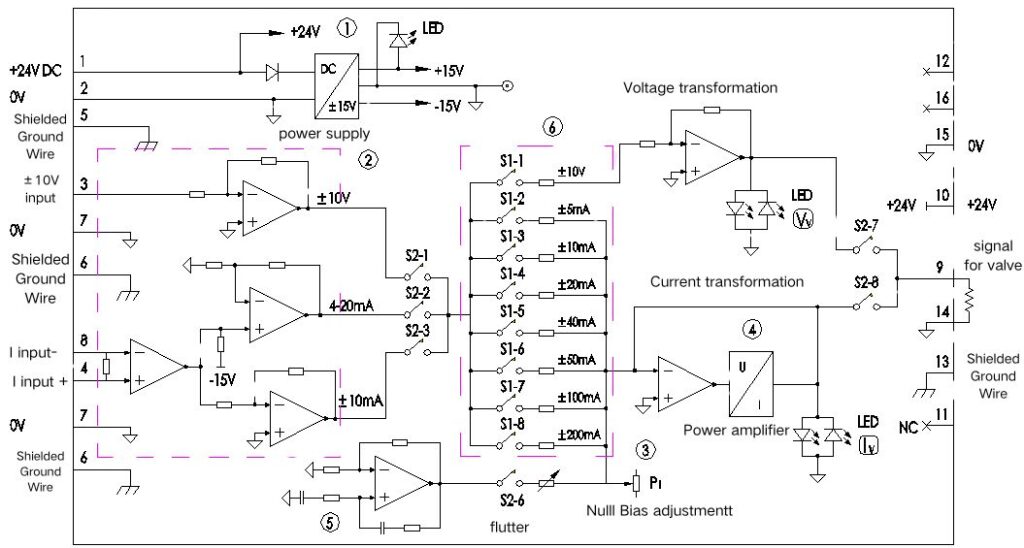
- Performance Check: Verify coil-to-pin connections per manual before power-on.
- Zero Adjustment: Adjust idle valve zero on a test bench (on-system adjustment gives system zero).
- Flutter Signal Adjustment: Tune frequency/amplitude based on individual valve differences to maximize resolution.
Contamination Control
Key measures: Prevent contamination intrusion, optimize system design, and implement effective filtration/maintenance.
- Filtration System: Equipped with high-pressure (pump outlet, pre-valve), low-pressure (main return), circulation, air, and magnetic filters. Pre-valve filter accuracy: 5μm (nozzle-flapper valve), 10μm (slide-valve). Internal coarse filter blocks large contaminants; inspect/clean/replace filters regularly.
- Pre-Installation Cleaning: Use a cleaning plate for system circulation; replace filters and test oil cleanliness until meeting standards before valve installation.
Instability Handling
Causes: Oil source pressure pulsation, relief valve instability, pipeline resonance, nonlinear limit cycle oscillation, servo valve clearance-induced positive feedback, hydrodynamic forces, etc.
- Solutions: Improve filtration/add flutter (reduce clearance-induced instability); adjust pipeline length/supports or actuator supports (mitigate resonance-related oscillations).