Key Takeaways
- A load-sensing proportional multi-way valve combines proportional control with load sensing (LS).
- Proportional control gives stepless speed by signal; LS keeps flow independent of load.
- PSL is for fixed-displacement pumps; PSV is for variable-displacement pumps with LS control.
- Fixed-pump banks use a three-way pressure compensator; variable-pump banks feed LS directly to the pump.
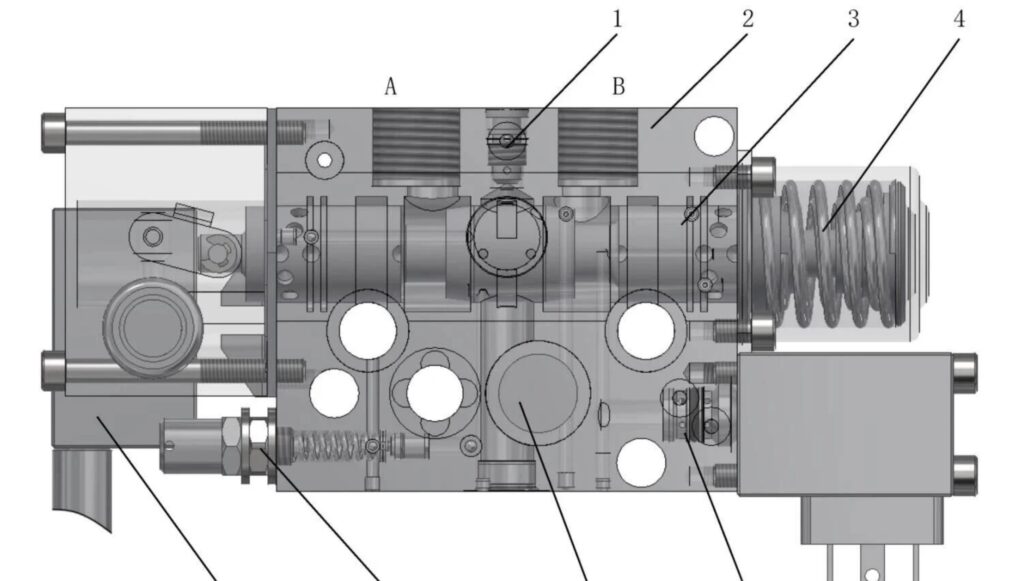
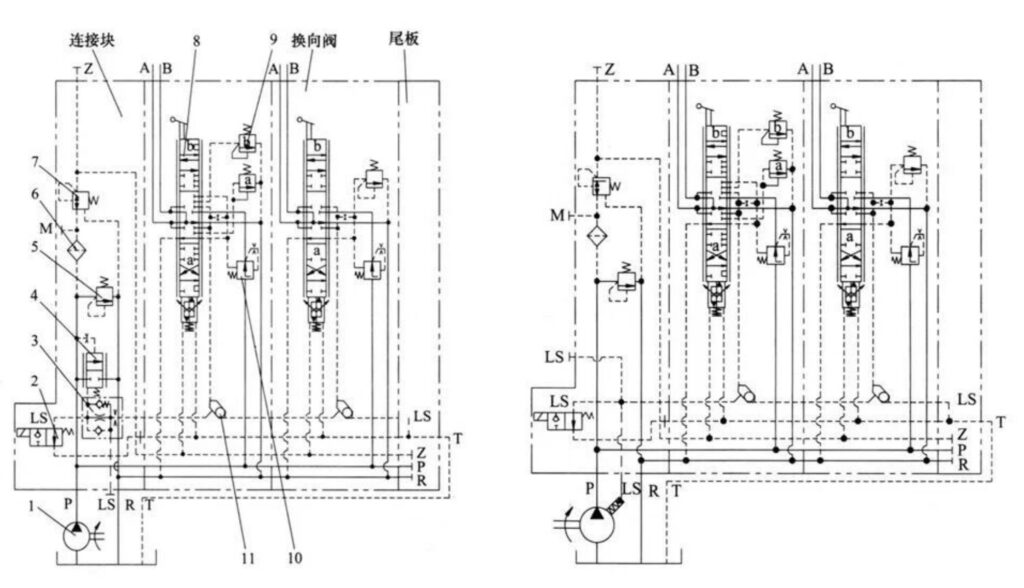
- The bank consists of a connection block, directional sections and an end plate.
What Is a Load-Sensing Proportional Multi-Way Valve?
A load-sensing proportional multi-way valve is a modular valve bank built around two or more proportional directional valves, with relief, overload and replenishing functions integrated in the same assembly. It adds proportional control to a conventional multi-way valve, so each actuator’s speed is set continuously by an electrical signal, while load sensing keeps that speed stable when the load changes.
In plain terms: the machine moves exactly where you point it, at the speed you choose, smoothly under any load — and with lower fuel consumption.
Proportional Control: Stepless Speed by Signal
Proportional control adjusts hydraulic flow continuously and proportionally in response to an electrical input (current or voltage). Spool displacement changes the flow area at the valve port, so output flow rises or falls linearly: small spool movement gives low flow and slow motion; large movement gives high flow and fast motion.
This sits between conventional on/off control and high-precision servo control, balancing cost, reliability and performance. On an excavator or crane, handle displacement is proportional to boom speed, so the motion is smoother and the work more efficient.
Load Sensing: Flow Independent of Load
With the main spool held at a fixed position (constant flow area), the output flow at the work port stays stable regardless of load pressure. The benefits are lower fuel consumption, lower heat, longer oil life, smoother motion and no “flow starvation” when several actuators work together.
Fixed vs Variable Pump Systems
| Fixed-displacement pump (PSL) | Variable-displacement pump (PSV) | |
|---|---|---|
| Connection block | Includes a three-way pressure compensator (constant-differential relief valve) | No three-way compensator |
| Pressure control | Pump outlet held about 10 bar above the highest load pressure; excess flow returns to tank | LS signal fed directly to the pump’s displacement control |
| Standby | Pump unloads at ~10 bar when all valves are neutral | Pump adjusts displacement to match demand |
| Energy behaviour | Low-pressure standby, no relief loss at neutral | No relief loss across the duty cycle |
In a fixed-pump system, the shuttle-valve network in the directional sections works with the three-way compensator to keep pump pressure about 10 bar above the highest load. The two-way compensator (constant-differential pressure-reducing valve) in each section lets actuators work independently at different pressures and speeds, with flow unaffected by load.
In a variable-pump system, the LS signal goes straight to the pump, which adjusts displacement to match required flow — no relief loss.
Core Advantages
- High efficiency — “pressure and flow on demand” avoids the energy wasted by a relief valve held open.
- Precise control — flow is independent of load, so actuator speed stays stable as load fluctuates.
- Independent actuators — flow is distributed on demand, without interference between functions.
Typical Applications
- Construction machinery — excavators, loaders, cranes, road rollers.
- Construction and municipal vehicles — concrete pump trucks, aerial work platforms, fire ladder trucks.
- Mining and coal machinery — roof bolters, self-advancing tailpieces; explosion-proof, low-current control underground.
- Agricultural and forestry machinery — tractors, combine harvesters.
- Marine machinery — deck cranes, winches.
PSL/PSV Series from Radk Hydro
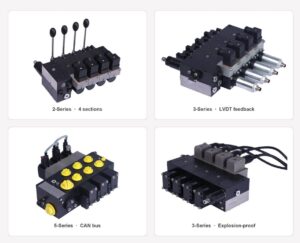
Our PSL/PSV load-sensing proportional multi-way valve range is built as a form-fit-function alternative to HAWE PSL/PSV banks, with the same mounting, ports and P/T/LS galleries. Three sizes cover most mobile applications:
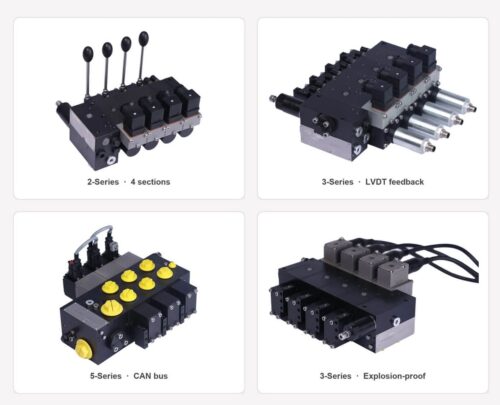
- 2-series PSL/PSV — up to 60 L/min per consumer, up to 12 sections.
- 3-series PSL/PSV — up to 120 L/min per consumer, up to 12sections.
- 5-series PSL/PSV — up to 240 L/min per consumer, up to 12 sections.
Each bank is configured with the connection block, directional sections and end plate for your circuit, with manual, hydraulic, pneumatic, electro-hydraulic or CAN actuation. Send a nameplate photo through our cross-reference form and we will confirm the size, spool functions and lead time.
FAQ
What is the difference between PSL and PSV? PSL is for fixed-displacement pumps; PSV is for variable-displacement pumps with a pressure/flow controller. The choice depends on the pump, not the machine.
What does load sensing mean? The valve senses the highest load pressure and keeps the pressure drop across the spool constant, so flow — and actuator speed — stays the same when the load changes.
Why does a fixed-pump system need a three-way compensator? It keeps pump pressure about 10 bar above the highest load and bypasses excess flow to the tank, so the system does not waste energy through a relief valve.
Can it replace a HAWE PSL/PSV bank? The mounting, ports and P/T/LS galleries are designed to match; confirm the model code and spool functions before ordering.
How many sections can one bank have? Up to 12 sections in sizes 2,3, and 5; larger systems can combine banks in series or parallel.
Last updated: November 2026
References: ISO 4401 mounting surfaces; HAWE PSL/PSV catalogue (for comparison); manufacturer test data.
Independent manufacturer. Not affiliated with, authorized by, or endorsed by HAWE Hydraulik SE.